Invest in Madinah Hospitality: Overcoming Delivery Hurdles by 2030
Invest in Madinah Hospitality: Overcoming Delivery Hurdles by 2030
Bridging Madinah’s 50,000-Room Gap: The Ultimate Hospitality Investment Frontier
Saudi Arabia is currently staging the largest and most ambitious tourism transformation in modern history. Fuelled by Vision 2030, the Kingdom is aggressively reshaping its economic landscape, shifting away from oil dependency and toward a dynamic, diversified future. At the heart of this strategy lies religious tourism.
While attention is frequently split across giga-projects like NEOM, the Red Sea, and Riyadh, the holy cities remain the bedrock of the country’s visitor economy. Among them, Madinah is experiencing an unprecedented evolution. However, beneath the gleaming master plans lies a stark mathematical reality: the city faces a massive supply crunch that conventional development speeds may struggle to solve.
The Numbers Behind the Crunch
To understand the scale of the opportunity, you have to look at the math.
- Current Inventory: Madinah currently operates around 75,000 hotel keys.
- The 2030 Requirement: Driven by national mandates, the city needs closer to 140,000 keys by the end of the decade.
- The Active Pipeline: Everything currently announced, planned, or under construction takes the total inventory to approximately 90,000 keys.
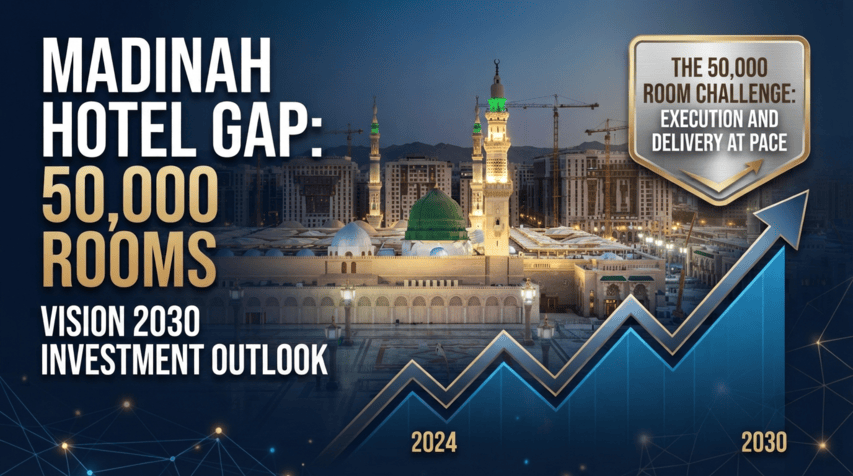
- The Deficit: Even if every single announced project hits completion without delays, the city is still short by roughly 50,000 rooms.
When you weigh this against the national pilgrim target climbing rapidly toward 30 million annual visitors, the scale of the challenge becomes crystal clear.
Demand Is Not the Problem
In most global real estate markets, a developer’s primary headache is securing occupancy—proving that a destination can attract enough heads in beds to justify the capital expenditure.
Must Read: مستقبل العاملين لحسابهم الخاص في المملكة العربية السعودية: اتجاهات السوق 2025
In Madinah, demand is a solved equation. Millions of Muslims from across the globe yearn to visit the Prophet’s Mosque year-round, turning the traditional seasonality of tourism on its head. Umrah is no longer restricted to a narrow calendar window; it is a fluid, year-round spiritual economy.
Because demand is virtually guaranteed, the traditional risk profile associated with hospitality investing looks completely different here. Occupancy rates are structurally resilient, and average daily rates (ADRs) are underpinned by unyielding, faith-driven footfall.
The Real Bottleneck: Delivery and Supply Chain Pressures
If demand is a given, what is holding the market back? Execution.
The true challenge in Madinah today is delivery. Developing real estate at this scale and pace exposes structural hurdles:
- Rising Construction Costs: Material costs are climbing globally, compounded locally by intense regional competition for raw materials.
- Equipment Scarcity: Quite simply, there is not enough specialized construction equipment, modular components, and heavy machinery to go around simultaneously across all of Saudi Arabia’s active giga-projects.
- Logistical Complexities: Building in dense, highly revered urban zones around the Haram requires meticulous planning, strict regulatory adherence, and zero room for error.
A structural gap of 50,000 rooms cannot be patched by ordinary means. It requires elite coordination, deep pockets, resilient supply chains, and seasoned operators who know how to navigate the local regulatory and cultural landscape.
Who Wins in the Madinah Market?
A supply gap of this magnitude creates a massive vacuum. That vacuum will inevitably be filled by whoever can actually build, finance, and operate at pace.
The winners in this landscape will not be those with just capital on paper, but those with operational agility. Modular construction techniques, strategic early-procurement partnerships, and seasoned asset management will separate successful ventures from stalled blueprints.
Those who are closely connected with the pioneers, tier-one contractors, and institutional financiers driving these projects recognize a generational truth: the right hotel project in Madinah does more than just plug a gap. It adds immense, compounding value to everyone involved—delivering robust, long-term yields for investors while offering a dignified, seamless experience for millions of visitors.
The Bottom Line
Madinah’s hospitality sector is moving faster than any other market segment in the region, yet the finish line of 2030 is approaching rapidly. The 50,000-room deficit represents both a formidable logistical hurdle and a once-in-a-lifetime window for visionary investors, developers, and hospitality leaders.
The blueprint is drawn, the demand is waiting, and the execution race has officially begun.